Finance workflow example#
This example illustrates a practical workflow for return-based information
dynamics. In finance, xyz is often most useful when framed as either:
a hedge-fund research toolkit for testing whether a signal contains incremental predictive information about future returns;
a market microstructure toolkit for measuring directional information flow between order-book state variables, trading activity, and short-horizon price changes.
Problem setup#
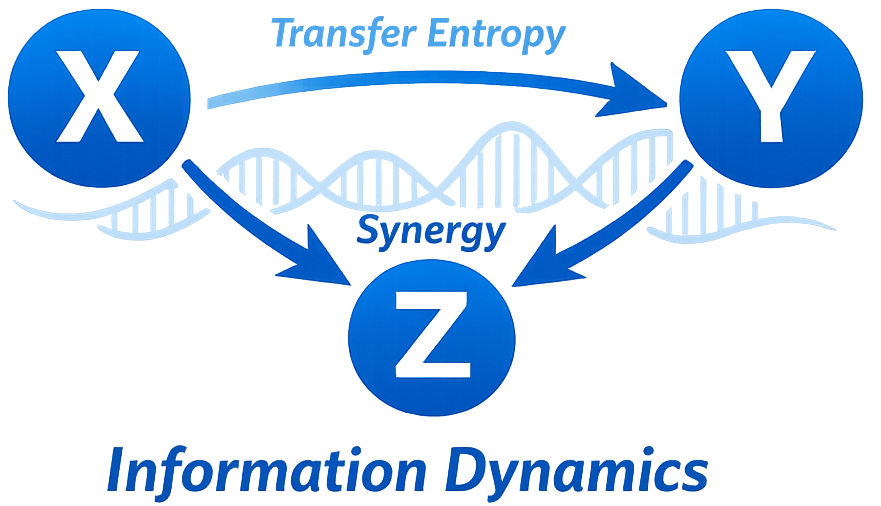
Y: target return (asset or portfolio).X: candidate driver (factor, market index, signal).Z: controls/confounders (other factors, volatility proxies, sector index).
Hedge-fund research framing#
For discretionary or systematic research, the core objects often look like:
Y: next-period return for an asset, spread, or portfolio sleeve.X: candidate alpha source such as carry, momentum, revisions, macro surprises, option-implied variables, or cross-asset moves.Z: benchmark risk controls such as market beta, sector indices, rates, credit spreads, volatility proxies, or competing signals.
Typical questions include:
Does a candidate signal still add information after controlling for known factors?
Is an apparent lead-lag effect still present after conditioning on the target’s own past?
Are two features redundant, uniquely informative, or synergistic when predicting the same target?
Does a relationship persist across rolling windows or disappear outside of a specific regime?
Suggested sequence#
Baseline linear inference
Fit
GaussianTransferEntropyandGaussianPartialTransferEntropy.Use
p_value_for quick significance screening.
Nonparametric confirmation
Fit
KSGTransferEntropy/KSGPartialTransferEntropy.Check robustness over
k(for example 3, 5, 8).
Storage diagnostics
Fit
KSGSelfEntropy(or Gaussian/Kernel variants) for persistence inY.
Sensitivity analysis
Vary lags/embedding size.
Compare metrics (Chebyshev vs Euclidean if needed).
Validate on rolling windows for nonstationarity.
Treat significance testing as part of the workflow, not an optional extra.
Useful interpretations#
GaussianTransferEntropy/KSGTransferEntropy: “Does signalXimprove prediction of futureYbeyondY’s own history?”GaussianPartialTransferEntropy/KSGPartialTransferEntropy: “Does that directed relationship survive after controlling for known risk driversZ?”KSGSelfEntropy: “How much of the target is explained by its own lagged state?”MVKSGCondMutualInformation: “Is this feature still informative after controlling for existing factors?”MVKSGPartialInformationDecomposition: “Are two signals redundant, unique, or synergistic?”
Code sketch: hedge-fund research#
import numpy as np
from xyz import (
    GaussianPartialTransferEntropy,
    KSGPartialTransferEntropy,
    KSGSelfEntropy,
)

# data columns: [target_return, candidate_signal, control_factor]
data = np.random.randn(3000, 3)

gpte = GaussianPartialTransferEntropy(
    driver_indices=[1],
    target_indices=[0],
    conditioning_indices=[2],
    lags=1,
).fit(data)

kpte = KSGPartialTransferEntropy(
    driver_indices=[1],
    target_indices=[0],
    conditioning_indices=[2],
    lags=1,
    k=3,
    metric="chebyshev",
).fit(data)

kse = KSGSelfEntropy(target_indices=[0], lags=1, k=3).fit(data[:, [0]])

print("Gaussian PTE:", gpte.transfer_entropy_, "p=", gpte.p_value_)
print("KSG PTE:", kpte.transfer_entropy_)
print("KSG SE:", kse.self_entropy_)
Market microstructure framing#
At higher frequency, replace asset-level factors with order-book and trade state variables:
Y: next mid-price move, short-horizon return, spread change, or volatility burst.X: order-flow imbalance, trade sign, queue depletion, cancellation bursts, depth imbalance, or venue-specific activity.Z: own-price history, spread regime, market state, auction flags, or broad benchmark features.
This framing is useful for questions such as:
whether order-flow imbalance contains incremental predictive information about the next price move;
whether one venue systematically leads another in a fragmented market;
whether a richer book feature adds unique information beyond simple trade imbalance;
whether naturally bucketed states are more transparent to study with discrete estimators before using continuous KSG variants.
Code sketch: discrete microstructure states#
import numpy as np
from xyz import DiscretePartialTransferEntropy, DiscreteSelfEntropy

# data columns: [midprice_state, imbalance_state, spread_state]
# each column can already be integer-coded, e.g. 0=down, 1=flat, 2=up
states = np.random.randint(0, 3, size=(5000, 3))

dpte = DiscretePartialTransferEntropy(
    driver_indices=[1],
    target_indices=[0],
    conditioning_indices=[2],
    lags=1,
    tau=1,
    delay=1,
    quantize=False,
).fit(states)

dse = DiscreteSelfEntropy(
    target_indices=[0],
    lags=1,
    tau=1,
    quantize=False,
).fit(states[:, [0]])

print("Discrete PTE:", dpte.transfer_entropy_)
print("Discrete SE:", dse.self_entropy_)
Practical notes#
Start simple: Gaussian estimators are often the best first screen when sample size is limited and the goal is ranking relationships quickly.
Use KSG estimators when you suspect nonlinear, heavy-tailed, or regime-shaped dependencies.
Use
InteractionDelaySearchCVandRagwitzEmbeddingSearchCVwhen the timing of the interaction is part of the research question.Use
SurrogatePermutationTestbefore trusting a weak TE edge in a noisy financial system.Prefer rolling or event-conditioned analyses over a single full-sample fit on nonstationary market data.