Belief propagation before survey propagation#
A distribution over assignments#
Assume there is at least one satisfying assignment and consider the uniform measure on satisfying configurations:
Here Z counts assignments, not clusters. A marginal \(\mu_i(x_i)\) asks how often a variable takes a value under this assignment measure. Belief propagation (BP), or sum-product message passing, approximates such marginals using local cavity distributions. The broader connection to statistical inference and Bethe approximations is reviewed in [ZK2016].
Two message directions#
Let \(m_{i\to a}(x_i)\) be the distribution of variable i when constraint a is removed, and \(\widehat m_{a\to i}(x_i)\) be the compatibility message from clause a. Factorization of independent branches gives
The Z factors normalize each two-component message. On a factor tree these equations follow by summing disjoint subtrees. For a positive-support measure, messages from leaves determine exact marginals after information has propagated across the tree. Hard constraints require consistent support: a zero normalization signals incompatible boundary conditions.
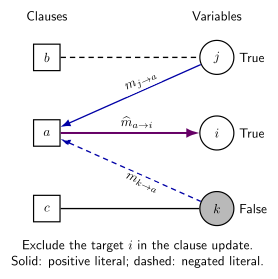
Fig. 2 The same signed incidence supports messages in both directions. An outgoing clause message excludes its target variable; an incoming variable message excludes the receiving clause. Colors show example truth values only, not message probabilities. Arrows indicate the update’s direction and leave solid/dashed literal signs intact. Other neighbors of b and c are omitted.#
For a clause, let \(u_{j\to a}\) be BP’s probability that j violates its literal in a. The clause is already satisfied when i takes its satisfying value, so the corresponding unnormalized factor message is 1. When i violates its literal, the factor message is \(1-\prod_{j\ne i}u_{j\to a}\). Thus BP reduces a local sum over configurations to a product for an OR clause. A variable marginal is obtained from the product over all incident clauses, followed by normalization.
What changes on a loopy graph?#
On a graph with cycles, deleting one edge does not generally make neighboring branches independent. Iterating BP treats them as approximately independent. A converged fixed point need not produce exact marginals; convergence itself is not guaranteed. Sparsity and locally tree-like neighborhoods motivate the approximation but do not eliminate long-range correlations.
In a clustered solution space, a global assignment measure can combine many internally correlated states. A single local distribution may conceal that a variable is forced True in some states, forced False in others, and variable within still others. An ordinary marginal of one-half can arise from very different state structures. This motivates passing distributions of state-level information rather than replacing every branch by a single assignment marginal.
Warnings and surveys#
A zero-energy clause warning is a binary statement: all its other literals are forced to violate the clause, so this variable must satisfy it. Warning propagation passes such state-level logical messages. Survey propagation passes their distributions across states, closing them with a cavity factorization assumption [BMZ2005] [BMWZ2003].
BP and SP therefore differ in their modeled objects and weighting. SP is not obtained by merely running the BP scalar probabilities with a different tolerance, nor by averaging arbitrary BP iterates. BSP.rs implements the SP warning-survey equations in the next chapter; it does not expose a BP solver.